

28th July 2026
Busy Season, Bigger Risks
Peak-season pressure is not just a hotel problem.
Gilly Farrell

WHY PEAK TOURISM STRETCHES FRONTLINE TEAMS
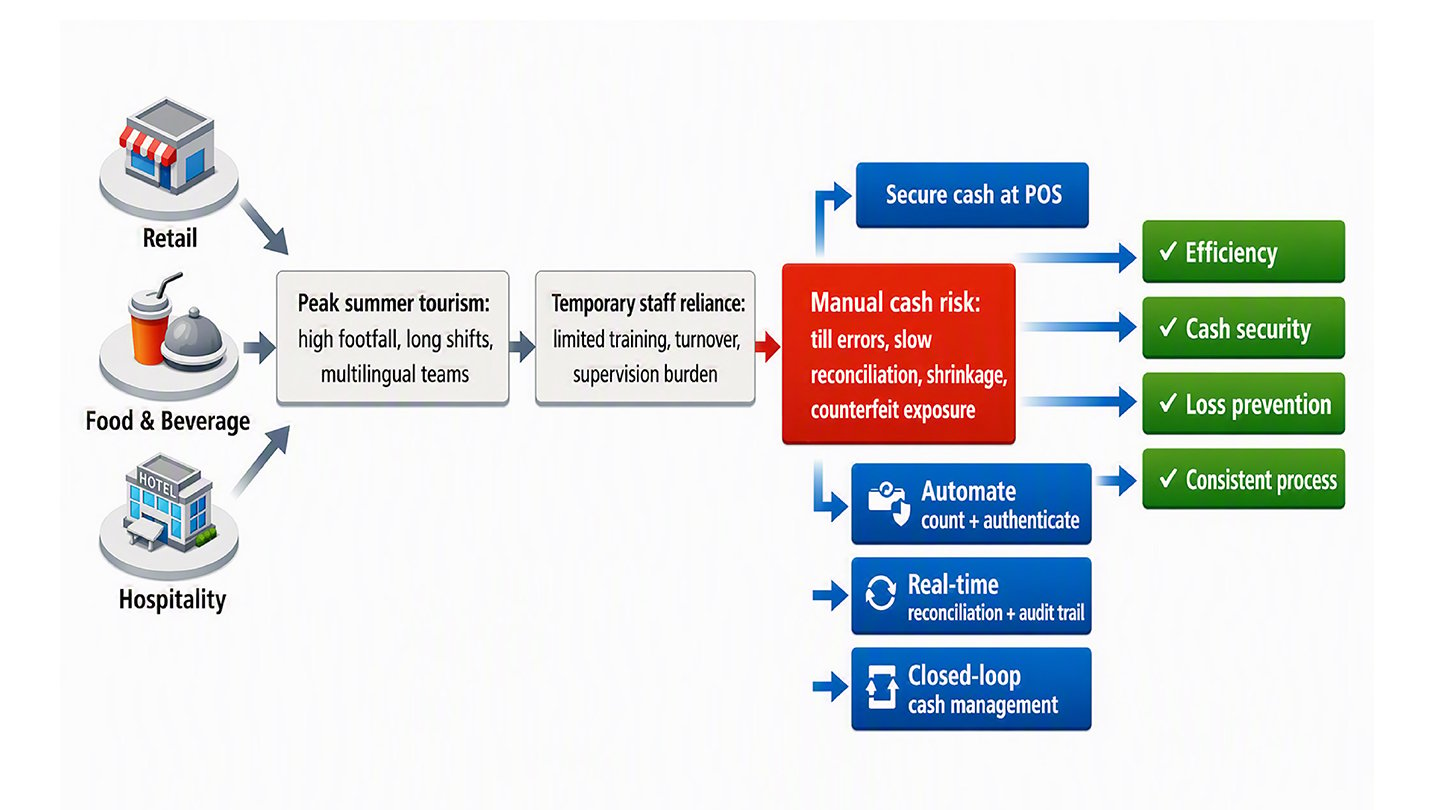
Every summer, high-tourism markets face the same operational challenge: more guests, more transactions and more pressure on frontline teams. The issue is not limited to hotels. Peak tourism flows through retail stores, cafés, bars, restaurants, convenience outlets, resorts, leisure venues and transport-adjacent services.
In the euro area, cash remained the most frequently used payment method at physical points of sale in 2024, accounting for 52% of POS transactions; it was used for 57% of payments in restaurants, bars and cafés, 53% in shops selling day-to-day items, and 33% in hotels, where cash transaction share increased from 2022. In Türkiye, food and beverage spending represented 19.4% of tourism income from visitors in 2024, showing how tourism demand directly touches F&B operations as well as accommodation.
Tourism Demand Across Key Markets




Where temporary staffing creates cash-handling risk
For businesses relying on seasonal or temporary staff, this creates a practical risk. New colleagues may have limited time to learn local procedures, may work across multiple tills or shifts, and may need to serve international customers quickly.
Industry cash-management analysis shows that cash discrepancies can stem from human error, technical issues or deliberate theft, and that manual reconciliation can be tedious, mistake-prone and difficult to investigate. Cash loss-prevention guidance also highlights that shared tills and delayed reconciliation make it harder to identify when and where a discrepancy began.
Cash automation as a peak-season resilience tool
That is where cash automation becomes a peak-season resilience tool, not just a back-office upgrade. GLORY’s cash automation approach helps secure cash at the point of sale, reduce manual counting, authenticate notes, record transactions in real time and identify discrepancies immediately. For retailers, GLORY materials describe quicker shift changes, reduced cash training requirements, more flexible staff deployment, real-time cash monitoring and 24/7 back-office automation. For restaurants and hospitality, GLORY materials position automation around secure cash management, cash loss prevention, automated POS reconciliation, business insight and queue management.

Cash automation helps standardise, secure and record the cash journey. across retail, food & beverage and hospitality.
- Secures cash at the point of sale, reducing exposure during busy trading periods.
- Reduces manual counting, helping new or temporary staff follow consistent processes.
- Authenticates notes and records transactions in real time, improving visibility and accountability.
- Supports faster reconciliation, making discrepancies easier to identify and investigate.
- Improves staff flexibility, allowing teams to focus more time on customers and guests.
Bottom line: Automation does not replace the human welcome that defines great hospitality and retail. It protects it. By reducing low-value cash tasks, businesses can keep staff focused on guests and customers, while improving accountability, reducing errors and strengthening loss prevention. When opening hours stretch, teams change shift more often and transaction volumes rise, the businesses that perform best will not simply be those with more people. They will be those with more consistent processes.
Peak tourism and temporary staffing pressure can make manual cash processes fragile.
Ready for the peak-season pressure test?